

Our vision
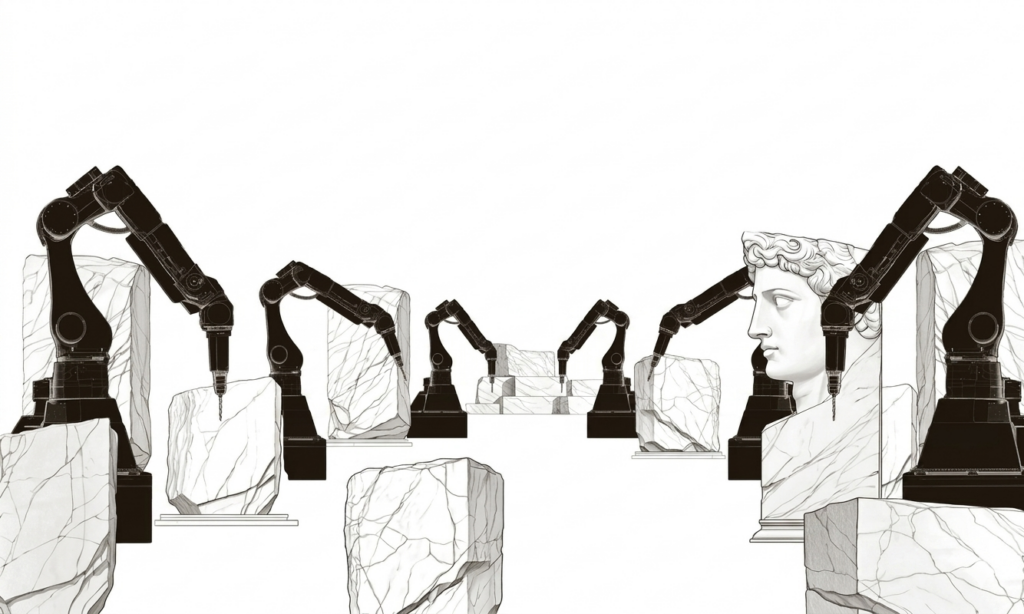
Reinventing stone
With technology and know-how, we can usher in a new golden age of art and architecture. After decades in which industrial efficiency took precedence over aesthetic ambition, we are convinced that robots and AI will enable artists and architects to bring bold and remarkable visions to life, quickly and cost-effectively.
Since our beginnings with our first robot and a stone cutter in July 2026, Ikonera has grown to bring together a team of designers, sculptors, manufacturers and engineers. Based in the Jura region of Switzerland, the workshop continues to grow by integrating new technological and craft capabilities.
With the infrastructure we are developing today, we will be able to produce large-scale ornamental structures and create exceptional new architectural forms. We are committed to reviving the art of stonework in Europe and beyond, by training a new generation of craftsmen and bringing together a community of collectors, architects and builders committed to artistic and architectural excellence.
Reinventing stone
With technology and know-how, we can usher in a new golden age of art and architecture. After decades in which industrial efficiency took precedence over aesthetic ambition, we are convinced that robots and AI will enable artists and architects to bring bold and remarkable visions to life, quickly and cost-effectively.
Since our beginnings with our first robot and a stone cutter in July 2026, Ikonera has grown to bring together a team of designers, sculptors, manufacturers and engineers. Based in the Jura region of Switzerland, the workshop continues to grow by integrating new technological and craft capabilities.
With the infrastructure we are developing today, we will be able to produce large-scale ornamental structures and create exceptional new architectural forms. We are committed to reviving the art of stonework in Europe and beyond, by training a new generation of craftsmen and bringing together a community of collectors, architects and builders committed to artistic and architectural excellence.
Robot + stone
in Switzerland :
crafts vs technology
For centuries, sculptors and stone have faced each other. Today, a third player is entering the studio — artificial intelligence. What does this change, for whom, and why has the category of «robotic sculpture» never really been defined?.
There's a question I'm often asked at design and architecture fairs: «Are you a sculptor or an engineer?» I always take a second before answering - not out of hesitation, but because the question itself reveals something important about the state of the sector. It assumes that these two worlds are separate. That creativity belongs to the craftsman, and precision to the machine. That the robot is the enemy of the hand.
This tension — craftsmanship versus technology — lies at the heart of every discussion about contemporary stone sculpture in Switzerland. And today, it deserves to be dismantled, piece by piece, just as one dismantles scaffolding that is no longer needed.
The Swiss stone workshop: a three-generation story
The first generation is that of the journeyman stonemason. A master and his stone, a chisel and a hammer, decades of training. These workshops embody a tradition of handing down skills that goes back to the medieval cathedrals. Their value is indisputable. Their scale, limited.
The second generation appeared with the first digital milling machines in the 1990s and 2000s. Progressive workshops integrated CNC machines to speed up certain repetitive tasks. The technology came assist the craftsman, without replacing him. The sculptor remained the centre of gravity of the project.
Today, something different is happening. And that's what IKONERA stands for: a third generation, A world in which artificial intelligence and robotics are no longer assistants - they are the architects of the possible.
What the robot changes - and what it doesn't replace
Let's start by clearing up a persistent misunderstanding: a 7-axis CNC robot does not does not sculpt strictly speaking. It runs. The difference is fundamental.
The industrial precision robot we use at IKONERA can reproduce with an accuracy of a tenth of a millimetre a shape that no one on earth could cut by hand within that timeframe. It can attack the material along seven simultaneous axes, creating impossible undercuts and algorithmic textures with a regularity that is beyond the reach of manual tools. He works at night. He never tires.
«Precision is not the enemy of art. It is the enemy of the unintended accident.»— Adelina Loshi, fondatrice IKONERA
But what the robot doesn't do - and never will - is deciding what is beautiful. Choosing the tension between a rough surface and a polished edge. Understand the space in which the piece will live. To sense what the client has not said, but which can be seen in his sketches. This intelligence remains entirely human.
At IKONERA, each layer does what it does best. The AI models and explores. The robot executes with a rigour that the hand cannot achieve. The craftsman's hand finishes where the material requires something that algorithms don't yet know how to name.
From block to finished piece: what really happens in the workshop
Let’s get down to specifics. When a project comes to IKONERA — be it a bust, a Corinthian capital or a monumental piece — it goes through a process in which every stage serves a specific purpose. None of them is merely decorative.
An idea, a sketch, an existing object or a scan is turned into a digital model in ZBrush and Rhino. This is where the proportions, materials and finishes are decided. The client can see their piece before a single gram of stone is touched — and can make changes at no extra cost.
Carrara marble, Jura limestone, Valais granite, translucent onyx: each block is selected at the quarry for its veining, density and how it responds to the chisel. A poor-quality block can ruin even the finest carving.
Diamond saws and blades remove the bulk of the material, after which precision cutters — some as small as 2 mm — bring the surface to within a fraction of a millimetre of its final finish. What used to take months to do by hand now takes just a few days.
The stonemason works on each surface: deliberate tool marks, polished areas, fine lines, and clean undercuts. Sometimes it takes a few hours, sometimes several weeks. It is this stage that distinguishes a machined piece from a work of art.
Supervised transport and on-site installation — in galleries, private collections, on building façades and in public spaces — working alongside engineers and specialist craftsmen where the project requires it.
The result of this production line: parts of a complexity once reserved for museum-scale projects, delivered within competitive lead times — and at a fraction of the cost of a fully manual production process.
Why generative AI is changing the very nature of projects
Here's what fundamentally distinguishes IKONERA from workshops that «also use a robot»: we don't use technology to speed up a pre-conceived idea. We use it to generate forms that would not have existed without it.
In practical terms: a client — a five-star hotel, a property developer, a collector — comes to us with a set of requirements. A space. A material. An atmosphere. A set of values. We translate these parameters into 3D models, parametric explorations, and forms that even the client hadn’t imagined they would want until they saw them. AI doesn’t decorate — it co-designs.
This is where the «craft vs technology» debate becomes a false dichotomy. It's not one or the other. It's a new category - what I call the'algorithmic workshop - in which artificial intelligence extends human creative capacities rather than constraining them.
The ecological question that nobody is asking
Compared with cast concrete - the ubiquitous substitute in prestige architecture - a sculpture in natural stone represents a reduction of the order of 70 % of CO₂ emissions throughout its entire life cycle. It does not deteriorate. It does not need repainting. It ages gracefully. A bench made of Jura limestone installed today will still be there in two centuries’ time.
Concrete, for its part, accounts for approximately 8 % of global carbon dioxide emissions. Quarrying and cutting stone requires relatively little energy — no firing at 1,450 °C, no clinker, no rusting reinforcement. And when it comes to reinforced structural stone, the figures are truly spectacular: up to 96 fewer tonnes of carbon and savings of 75 % compared with an equivalent steel-concrete structure.
What «sustainable» means in stone sculpture
A natural stone sculpture created by IKONERA is not «responsible» because it ticks ESG boxes. It is sustainable by nature: extracted once, worked once, installed once, for decades to come.
Limestone from the Swiss Jura can be found in medieval buildings in Porrentruy and Haussmann-style buildings in Paris. It doesn't have to reinvent itself every five years. That's sustainability in stone: not a certification, but a physical property.
Switzerland today: where do we really stand?
Switzerland is home to some of the most respected stone-cutting workshops in Europe. Training to become a stonemason is among the most rigorous in the world, with standards of excellence jealously guarded by professional structures that are firmly rooted in the fabric of French-speaking Switzerland.
But the reality of the market is this: demand for complex, bespoke pieces with fast delivery is skyrocketing — driven by the luxury hotel sector, ultra-premium property developers, galleries and collectors. And traditional craftsmanship cannot meet this demand on such a scale. This is not a criticism. It is a structural reality.
«Swiss stone craftsmanship is irreplaceable. It doesn't need to be replaced - it needs an amplifier.»- IKONERA, founding manifesto
IKONERA was not born in opposition to the world of craftsmanship. It was born of the conviction that the two worlds, working together, create something that neither could produce alone: pieces of a formal complexity that was previously impossible, made to competitive deadlines, with the tactile finesse that only the human hand can provide.
What this means for you in practical terms
A new category only makes sense if it opens doors that were previously closed. Here is what the algorithmic workshop makes possible, depending on who you are:
Architects & developersDecorative art is becoming profitable again
Dome roofs, friezes, corbels, neoclassical or parametric façades: features that used to cost as much as an entire floor are now within a reasonable budget. The faithful restoration of listed features can now be carried out quickly and accurately, using nothing more than a simple 3D scan.
Collectors & galleriesThe one-of-a-kind piece, with no compromises
Each piece is unique by design: a 3D model agreed upon together, a block selected from the quarry, and a hand-finished finish. From classic busts to impossible parametric forms — including backlit onyx.
Artists & sculptorsAn amplifier, not a competitor
You provide the design — or the idea. We bring it to life, full-scale and in the material of your choice, with your personal touch. From the digital design right through to the finishing touches and installation, our workshop becomes an extension of your studio.
Defining the new category: the algorithmic workshop
Algorithms workshop (n.m.)
A production facility that integrates generative artificial intelligence, multi-axis precision robotics and traditional craftsmanship in a continuous process, to create bespoke works in natural materials.
In contrast to the craft workshop (centred on the human gesture) and the industrial workshop (centred on volume), the algorithmic workshop is centred on singularity Each piece is unique by design, impossible to produce in any other way and impossible to reproduce identically.
This is where IKONERA fits in. Not between the artisan and the industrial - but somewhere else, on a third line that didn't exist five years ago and that will define the built aesthetics of the next decade.
The next time someone asks me if I'm a sculptor or an engineer, my answer will be simple: «Neither. I run an algorithmic workshop.»
Frequently asked questions
Does a robotic sculpture have the same value as a hand-carved sculpture?
The question boils down to whether a photograph is equivalent to a painting: they are two different processes. At IKONERA, the robot does not replace the human hand — it paves the way for it. Each piece is finished by a stonemason, bears the marks of the tools used, and remains unique by design. The value lies in the uniqueness of the design, the material and the finish.
What materials can be carved?
Marble (Carrara, Calacatta Oro, Vert des Alpes), limestone (Jura, travertine), Valais granite, sandstone (Vosges, Swiss molasse), translucent onyx — selected directly from the quarry. The choice depends on the application: exterior, interior, backlit room, structural element.
How long does it take to make a bespoke item?
From a few weeks for a decorative element to a few months for a monumental piece — a fraction of the time it would take to carve entirely by hand. Upstream 3D modelling eliminates unpleasant surprises: you approve the piece before the stone is even touched.
Are you working on an existing object or building?
Yes. We scan objects and architectural features using 3D scanners — or even a mobile phone — to reproduce them faithfully, restore them or reinterpret them. This is at the heart of our heritage restoration work.
How do I get a quote?
Our online calculator provides an initial estimate in just a few clicks, based on size, material and complexity. For an architectural project or a bespoke commission, an appointment at our workshop in Alle (Jura) allows us to work together to refine the specifications.
a form that no-one has yet imagined
Estimate your sculpture in 60 seconds with our online calculator.
Estimate my project →
Read our
latest articles
7 axes, 35 tonnes, 0.1 mm: inside the robot carving the stone
7 axes, 35 tonnes, 0.1 mm: inside the robot that carves stone How does an industrial carving robot really work? Take a look at IKONERA's technical process. ...
Read the full article
Stone vs Concrete: what if the sustainable choice was also the more beautiful one?
Stone vs Concrete: what if the sustainable choice was also the more beautiful one? Modern construction has chosen concrete for its cost. But no one has really calculated...
Read the full article
The ancient art of stone meets artificial intelligence
The ancestral art of stone meets artificial intelligence For thousands of years, man has been sculpting stone. IKONERA reinvents this art - without betraying it. Stone, the material of eternity Marble...
Read the full article
When facades come to life: architectural sculpture in the 21st century
When facades come to life: architectural sculpture in the 21st century Beauty has disappeared from architecture not because of artistic choice - but because of cost. IKONERA is changing the game....
Read the full article
Saving the monuments of the past with the tools of the future
Saving the monuments of the past with the tools of the future The restoration of architectural heritage is in crisis. IKONERA provides a concrete, rapid and faithful response. The...
Read the full article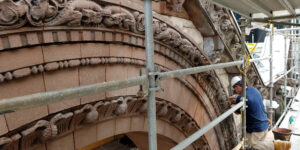
Our team
We are reviving the art of stone in Europe, using robots and AI to cut costs, while training a new generation of craftsmen capable of transforming stone into works of art and exceptional architecture.

 French
  English
  German
  Italian