

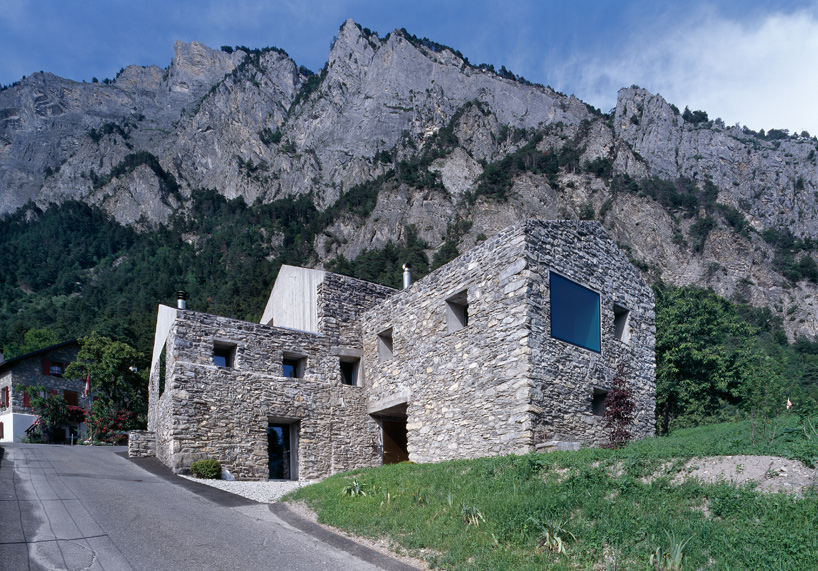
Stone vs Concrete: what if the sustainable choice was also the more beautiful one?
Stone vs Concrete: what if the sustainable choice was also the more beautiful one?
Modern construction has chosen concrete for its cost. But no one has really calculated the real cost - environmental and aesthetic.
Concrete: a choice that changed everything
Reinforced concrete is now the most widely used material in construction worldwide. Yet it alone accounts for around 8% of global CO₂ emissions. Its production requires massive amounts of energy, generates chemical residues that are difficult to treat, and produces structures whose real lifespan rarely exceeds 50 to 80 years before significant deterioration.
We chose concrete because it was cheap to produce. We're only now beginning to realise what it really costs in the long term - to the environment, the urban landscape and the architectural identity of our towns and cities.
Stone: a material that lasts 10 times longer
Natural stone - marble, granite, limestone - has environmental properties that concrete simply cannot match. It requires no chemical treatment. It is infinitely recyclable: an unused block of marble can be reworked, recut and reused. It lasts for centuries without deteriorating - the Greek temples bear witness to this. And above all, it requires up to 8 times less energy to transform than concrete.
These are objective facts. Stone is not inherently a luxury material - it has become a luxury material because the skills needed to work it have become scarcer, and because the time required for artisanal workshops has become economically incompatible with the pace of contemporary construction.
The IKONERA workshop: designed for minimum impact
IKONERA has designed its production workshop to incorporate environmental constraints right from the design stage. The cutting waste - stone dust and limestone sludge (CaCO₃) - is inert, non-polluting mineral waste that can be recycled in agriculture, ecological concrete or terrazzo. 90 to 95% of the water used in the process is recycled in a closed circuit.
Acoustically, noise in the workshop is reduced to less than 45 dB outdoors - below the 50 dB threshold set by the Swiss FOEN. The robot's power consumption is around 20 kW, the equivalent of a few domestic households - to produce parts that will last for centuries.
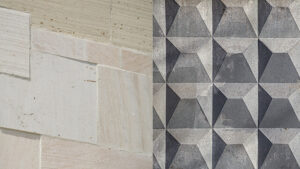
Reintroducing stone into construction: an act of sustainability
While IKONERA makes stone sculpture accessible on a large scale - facades, architectural elements, street furniture - it is also a long-term ecological choice. Building with natural stone means building for 200 years. It's a choice for a living material that's rooted in its territory and won't end up in a landfill after a few decades.
Beauty and sustainability are not mutually exclusive. IKONERA demonstrates this, in concrete terms, from the Swiss Jura.
→ Find out more about our responsible approach: ikonera.art

 French
  English
  German
  Italian